Back of the envelope
Sources
- Matthew Bill post
- Latency Numbers Every Programmer Should Know
- ByteByteGo
- Appendix 3 of System Design Interview – An insider’s guide
- Developing High-Frequency Trading Systems
Unit
- Thousands = Kilo (3 zeros)
- Millions = Mega (6 zeros)
- Billions = Giga (9 zeros)
- Trillions = Tera (12 zeros)
- Quadrilions = Peta (15 zeros)
- Milli = 10^(-3)
- Micro = 10^(-6)
- Nano = 10^(-9)
- Pico = 10^(-12)
Latency Numbers Programmer Should Know
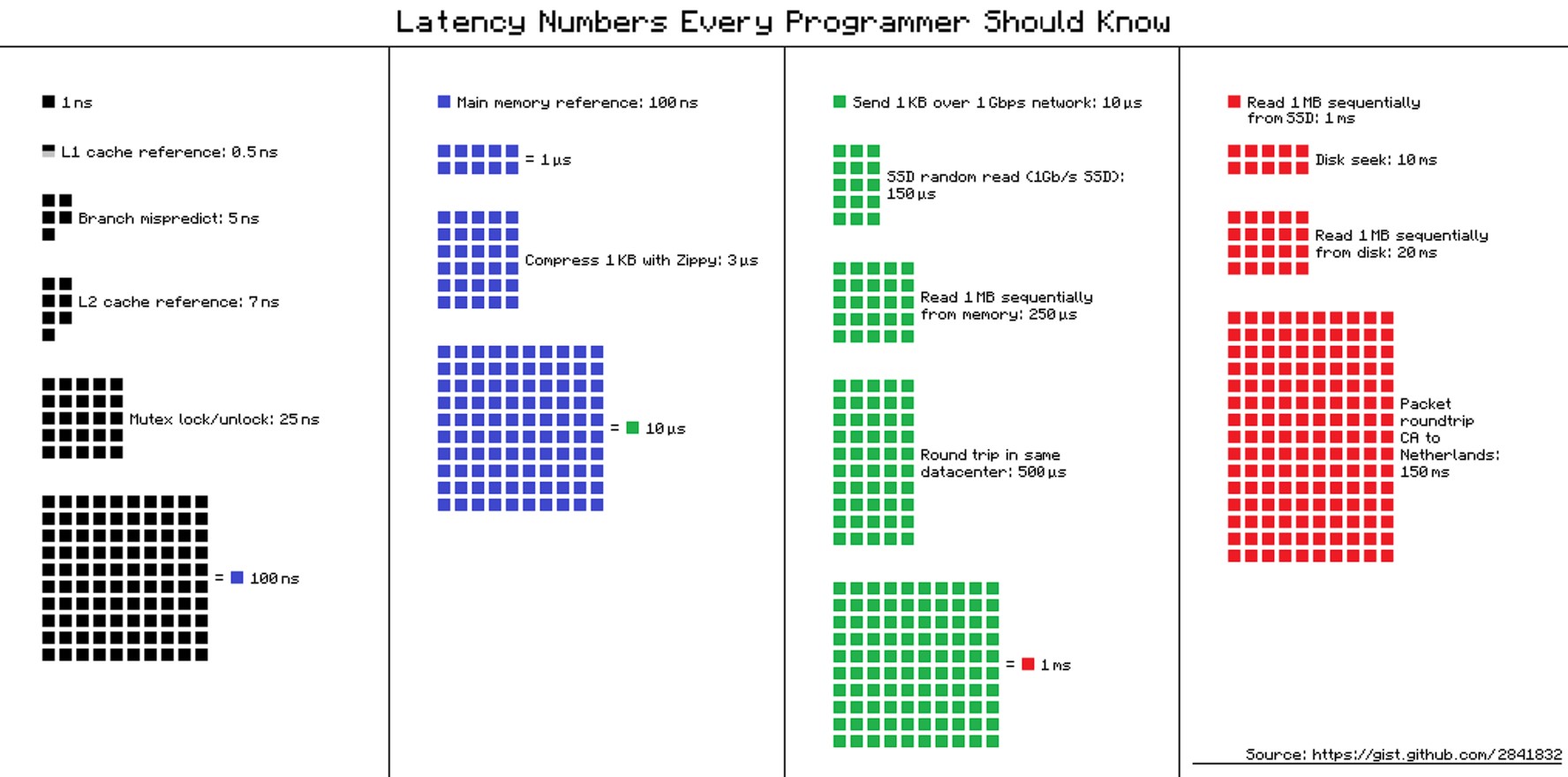
<1 ns / sub-nanos
--------------------------------------------------------------------
A clock cycle
L1 cache reference                         0.5   ns

1 - 10 ns
--------------------------------------------------------------------
Branch mispredict  (~20 clock cycle)         5   ns
L2 cache reference                           7   ns     14x L1 cache

10 - 100 ns
--------------------------------------------------------------------
L3 cache reference                    10 - 100   ns
Mutex lock/unlock                           25   ns
Main memory reference                      100   ns                      20x L2 cache, 200x L1 cache

100 - 1000ns
--------------------------------------------------------------------
md5 hash on 64bit int                      200   ns
Compress 1K bytes with Zippy             3,000   ns
System call                              generally few hundreds ns

1 - 10us  (about thousands times slower than CPU register access)
--------------------------------------------------------------------
context switching between Linux threads     generally few micros (if without paging)
Coping 64KB between 2 main memory location  generally few micros as well

10 - 100us
--------------------------------------------------------------------
nginx network proxy for http request        50   us
reading 1MB sequentially in main memory     50   us
reading 8K page in SSD                     100   us

100 - 1000us
--------------------------------------------------------------------
intra-zone network round trip       few hundreds us
writing a page to SSD                     1,000  us      10x slower than SSD read
typical Memcache/Redis get ops            1,000  us

1 - 10 ms
--------------------------------------------------------------------
inter-zone network round trip                 5  ms
seek time of HDD                              5  ms

10 - 100 ms
--------------------------------------------------------------------
US east coast to Europe
Read 1 GB sequentially from memory

100 - 1000 ms
--------------------------------------------------------------------
encrypt a password                         300   ms
TLS handshake                        250 - 500   ms
US west coast to Singapore
Read 1 GB sequentially from SSD

> 1s
--------------------------------------------------------------------
Transferring 1GB over network               10  s
within the same cloud regions
Cache sizes
- Cacheline: 64 bytes (x86 machine)
- L1: D/I cache - 32KB or 64KB per core
- L2: 256KB or 512KB (could be per core or shared up to 2 cores)
- L3: May vary from 8MB to 32MB (could be shared across all cores or may be sliced to multiple instances to be associated per core or dual/quad cores)
Geographic distance
(in KM)
    4K       6K                 10K              10K
SF ---- NY ------ Amsterdam ---------- Taiwan -------..>SF
|________________________________________________________|| LS = light speed | single way latency minimum |
|---|---|
| 4K / LS | 13 micros |
| 6K / LS | 20 micros |
| 10K / LS | 33 micros |
Common network bandwidth
- The maximum amount of data that goes through the cable per second is called the bandwidth.
- Bandwidth is usually measured in bits per second not bytes per second.
- The standard supported network speed is single-lane 100 gigabits per second (Gbps), 25 Gbps, and 10 Gbps signaling.
- Anything else (that is, 400 Gbps, 50 Gbps, 40 Gbps, and so on) comprises multiple parallel lanes.
Useful Calculations
x Million users * y KB (per user) = xy GB- example: 1M users * a documents of 100KB per day = 100GB per day.
x Million users * y MB (per user) = xy TB- example: 200M users * a short video of 2MB per day = 400TB per day.
Approximation
1 day is about 100K seconds
1 month is about 3M seconds
- 1 million requests per month ~= 10 10^5 / (3M) = 0.13 = 0.3 requests per seconds
- 1 billion requests per month ~= 10 10^8 / (3M) = 1003 = 300 requests per seconds
Usage
Users cnt
- Facebook: 2.27B
- YouTube: 2B
- Instagram: 1B
- Pinterest: 332M | Twitter: 330M | Onedrive: 250M
- TikTok: 3.7M
- Facebook: 26.12B
- Twitter: 6.34B
- Pinterest: 1.32B
Cost of Operations
- Read sequentially from HDD: 30 MB/s
- Read sequentially from SSD: 1 GB/s
- Read sequentially from memory: 4 GB/s
- Read sequentially from 1Gbps Ethernet: 100MB/s
- Cross continental network: 6–7 world-wide round trips per second.
| Month | Storage | Connections | Requests/sec | Throughput |
|---|---|---|---|---|
| SQL DB | 600TB | 30K | 25k | - |
| Cache | 300GB | 10K | 100k | - |
| WebServer | - | - | 5 - 10k | - |
| Queue/Stream | - | - | 1 - 3k | 1 - 50MB/s (Write), 2 - 100MB/s (Read) |
| Scrapers | - | - | 1k | - |
Last updated on