Data structures: Union–find data structure
- a.k.a disjoint set or merge–find
- Allow us to quickly identify whether a path exists between a given pair of vertices.
- Maintain a partition of a static set of objects. In the initial partition, each object is in its own set. These sets can merge over time, but they can never split.
- Just two operation as name suggests: union and find
- Union-find application in graph:
- A union-find data structure is born with each object in a different set. Whenever a new edge (v, w) is added to the solution-so-far, the connected components of v and w fuse into one, and one Union operation suffices to update the union-find data structure accordingly. Checking whether an edge addition (v, w) would create a cycle is equivalent to checking whether v and w are already in the same connected component.
- Union-find data structure can be viewed as a disjoint-set forest consists of a pointer used to make parent pointer trees, where each node that is not the root of a tree points to its parent. Each tree represents a set stored in the forest, with the members of the set being the nodes in the tree. Root nodes provide set representatives: Two nodes are in the same set if and only if the roots of the trees containing the nodes are equal.
find
- The Find operation follows the chain of parent pointers from a specified query node x until it reaches a root element. This root element represents the set to which x belongs and may be x itself. Find returns the root element it reaches.
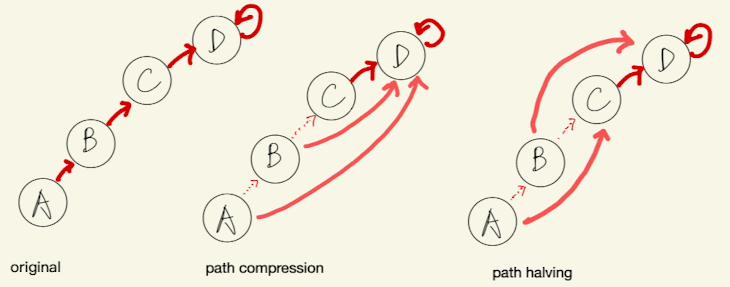
Optimization: Path compression
- Performing a Find operation presents an important opportunity for improving the forest.
- The time in a Find operation is spent chasing parent pointers, so a flatter tree leads to faster Find operations.
- When a Find is executed, there is no faster way to reach the root than by following each parent pointer in succession. However, the parent pointers visited during this search can be updated to point closer to the root. Because every element visited on the way to a root is part of the same set, this does not change the sets stored in the forest. But it makes future Find operations faster, not only for the nodes between the query node and the root, but also for their descendants. This updating is an important part of the disjoint-set forest’s amortized performance guarantee.
NOTE: easily mess up: forget to
return parent_[nodeIdx] == nodeIdx? nodeIdx, which would have caused an infinite loop.
// std::vector<int> parent_;
// parent_ = std::vector<int>(nodeCnt, -1);
int find(int nodeIdx) {
  if (parent_[nodeIdx] == -1) parent_[nodeIdx] = nodeIdx;
  return parent_[nodeIdx] == nodeIdx? nodeIdx
         : parent_[nodeIdx] = find(parent_[nodeIdx]); // the path compression
}
Iterative way to do the find with path compression
//std::vector<int> parent_;
// NOTE: assume node point to itself as initialization!
//parent_ = std::iota(begin(parent_), end(parent_), 0);
int find(int nodeIdx) {
  int finalRoot = nodeIdx;
  while (finalRoot != parent_[finalRoot]) finalRoot = parent_[finalRoot];
  while (nodeIdx != finalRoot) {
    int oriParent = parent_[nodeIdx]; // store the original parent
    parent_[nodeIdx] = finalRoot; // assign parent as the final root
    nodeIdx = oriParent; // point to the original parent and keep doing it
  }
  return root;
}
Path compression with path splitting/path halving
- assume node point to itself as initialization!
- “halving” because you keep pointing to grandparent
- This way retains the same worst-case complexity but are more efficient in practice
//std::vector<int> parent_;
// NOTE: assume node point to itself as initialization!
//parent_ = std::iota(begin(parent_), end(parent_), 0);
int find(int nodeIdx) {
  while (parent_[nodeIdx] != nodeIdx) {
    int oriParent = parent_[nodeIdx];       // store the original parent
    parent_[nodeIdx] = parent_[oriParent];  // point to grandparent basically
    nodeIdx = oriParent;
  }
  return nodeIdx;
}
union
NOTE: easily mess up - doing
parent_[x] = yRootor alike. No it’s not, you are not just assign x’s parent to y, you are point x’s grandparent instead.
Say A -> B; D -> E, you are trying to join A and D. If you only point parent[A] = E, it would be A -> E; D -> E; B -> B. e.g. B isn’t connected to E like you intended to. But if you do
parent[parent[A]] = E; parent[B] = E, then the graph becomes: A -> B -> E; D -> E.
void unionJoin(int nodeX, int nodeY) {
  const auto xRoot = find(nodeX);
  const auto yRoot = find(nodeY);
  if (xRoot != yRoot) parent_[yRoot] = xRoot;
  // or
  // if (xRoot != yRoot) parent_[xRoot] = yRoot;
}
Merge smaller to larger to achieve better amortized time complexity.
- To ensure good performance of union/find, we want to keep the depth of the union-find tree small.
- When we join two sets, we need to decide which set should be merged into the other. If we merge a smaller set into a larger set, the depth of the resulting tree will (likely) be smaller, as smaller set is likely to have lower depth and vise versa. This reduces the time complexity of the find operation.
- Therefore, it is recommended to merge the smaller set into the larger set.
- To achieve a good amortized time complexity, we can use the weighted union heuristic, which involves keeping track of the size of each set and always merging the smaller set into the larger set. This can help ensure that the depth of the tree is kept small, leading to a better overall performance.
struct DisjoinSet {
DisjoinSet(int n) : sz(n) {
  groupsSz = std::vector<int>(n, 1);
  // other initialization
}

void join(int a, int b) {
  int x = findParent(a);
  int y = findParent(b);
  if (x != y) {
    // always merge smaller group to larger one so that the depth of merged
    // groups is likely to be smaller
    if (groupsSz[x] > groupsSz[y]) {
      std::swap(x, y);
    }
    parents[x] = y; // smaller group x's parent assign to larger group
    groupsSz[y] += groupsSz[x]; // larger group y's size updated
  }
}
};
Last updated on