Range query: Segment tree
- Original taking notes from watching YT video
Use case - A query about an range
Example: query maximum within range
- Say you have an array of integers. User will query with a range [l, r]
- You need to return the maximum between [l, r]
- Naively, if you iterate l to r for each query to find the maximum, every query is a O(n) search.
- Segment tree reduce this query to O(logn)
Example 2: Range query
Basic tree representation
- say root node idx is
i- left node idx is
2 * i + 1 - right node idx is
2 * i + 2
- left node idx is
- A node stores value based on the query context.
- Say a node represents range within [L, R]
- M = L + (R - L) / 2
- left node represents range within [L, M]
- right node represents range within [M+1, R]
- Leaf node basically represents the original input, which has a range of l == r
- Root node represents the full range
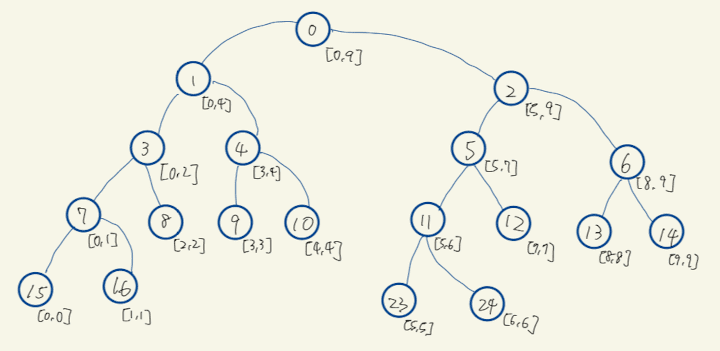
How to build the tree
- Build is based on the query - For example, query the max of a range:
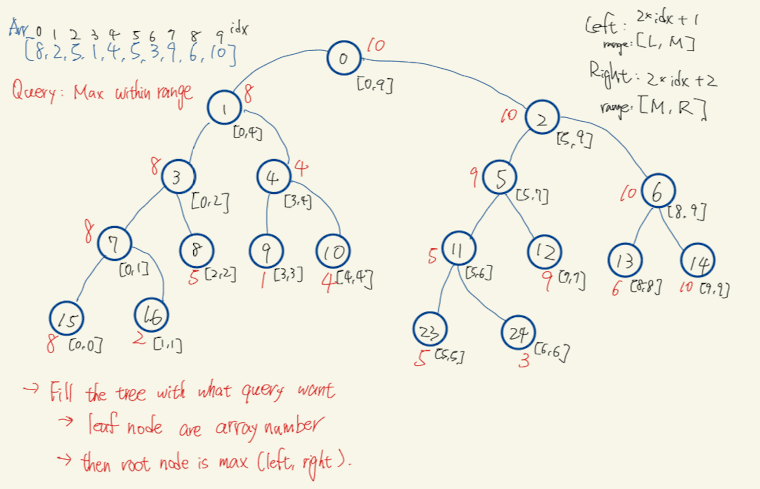
- Check this question
How to update the tree
- Overall very similar how to build the tree. The difference when we update, we only need to either update left or right, depends on whether the updated node is before mid or after.
- Check this question
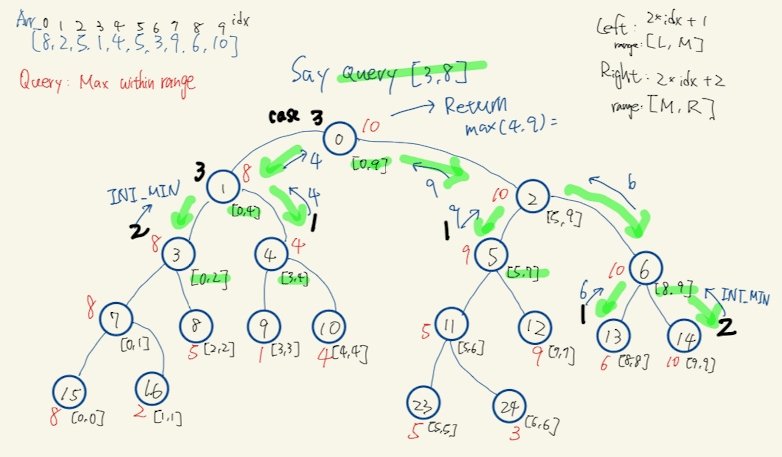
How to query
- Return value is based on the query of the range.
- The main idea is that each siblings are having mutual exclusive range. So it’s about how to traverse the tree and composite the full range.
- Case 1: node range is completely covered by the query range:
return node value(as you don’t need to go down further) - Case 2: node range is out side of query range: return a value that can represents a do nothing as the context of the query.
- For example:
return INT_MINif finding max.return 0if finding range sum.
- For example:
- Case 3: node range (partial or full) overlap with query range: return a value represents query within the range
return min(left, right)if finding range maxreturn sum(left, right)if finding range sum
- Case 1: node range is completely covered by the query range:
- Check this question
Size of segment tree node array: $O(4n)$
- Say full range is n, which means leaf nodes is at least n
- Say N is the min of pow of 2 that >= n, e.g. N = $2^{\lceil log_2{n} \rceil}$
- Since segment tree is a complete tree, the hight of tree should be $h = \lceil log_2{N} \rceil + 1$
- The maximum number of nodes in a complete binary tree is $2^{h} - 1$
- So the size needed equal to $2^{log_2{N} + 1} - 1$ = $2 2^{log_2{N}} - 1$ = $2 N - 1$
- As $N <= 2 n$, size needed will be $2 2 n - 1$ = $O(4n)$
Question collection
- :point_right: :notebook:
Last updated on