3.8.1 Sockets
-
Definition and Use:
- A socket is an endpoint for communication between two processes on a network.
- Communication involves a pair of sockets, one for each process.
-
Identification:
- Sockets are identified by an IP address and a port number.
-
Client-Server Architecture:
- Utilizes a client-server model where the server listens on a specified port for client requests.
- Servers for specific services listen on well-known ports (e.g., SSH on port 22, FTP on port 21, HTTP on port 80).
- Well-known ports are below 1024.
-
Client Connection Process:
- The client is assigned a port number greater than 1024 by its host for the connection.
- Example: A connection between a client (146.86.5.20:1625) and a web server (161.25.19.8:80).
- Each connection is unique; another process on the same host would be assigned a different port number.
-
Loopback Address for Testing:
- The IP address 127.0.0.1 (loopback) is used for communication between client and server on the same host.
- Loopback allows testing of TCP/IP communication without network infrastructure.
-
Communication Characteristics:
- Sockets enable an unstructured stream of bytes to be exchanged, requiring the application to impose data structure.
- Sockets represent a low-level form of communication compared to higher-level methods like remote procedure calls (RPCs).
3.8.2 Remote Procedure Calls
-
RPC Fundamentals:
- Designed to abstract procedure calls over networks, similar to Inter-Process Communication (IPC) but for remote systems.
- Uses structured messages for communication, specifying functions and parameters.
-
Communication Process:
- Messages are addressed to an RPC daemon listening on a specific port on the remote system.
- RPC communication involves executing a specified function and returning the output to the requester.
-
Ports and Daemons:
- Systems can support multiple network services, each differentiated by unique port numbers.
- RPC daemons attached to ports enable specific services (e.g., listing current users on port 3027).
-
Client-Server Interaction:
- RPC hides communication details through stubs, which marshal parameters and manage message passing.
- Windows uses Microsoft Interface Definition Language (MIDL) for defining client-server interfaces.
-
Parameter Marshaling:
- Addresses data representation differences (big-endian vs. little-endian) with machine-independent formats like XDR.
- Involves converting data into a common format before transmission and back on reception.
-
Call Semantics:
- Unlike local calls, RPCs may fail or duplicate due to network issues. Solutions include “at most once” and “exactly once” semantics.
- “At most once” uses timestamps to prevent duplicate processing;
- This semantic can be implemented by attaching a timestamp to each message.
- The server must keep a history of all the timestamps of messages it has already processed or a history large enough to ensure that repeated messages are detected.
- Incoming messages that have a timestamp already in the history are ignored.
- The client can then send a message one or more times and be assured that it only executes once.
- “exactly once” adds acknowledgments (ACK) to ensure message receipt and execution.
- we need to remove the risk that the server will never receive the request.
- To accomplish this, the server must implement the “at most once” protocol described above but must also acknowledge to the client that the RPC call was received and executed.
- These ACK messages are common throughout networking.
- The client must resend each RPC call periodically until it receives the ACK for that call.
-
Binding and Port Discovery:
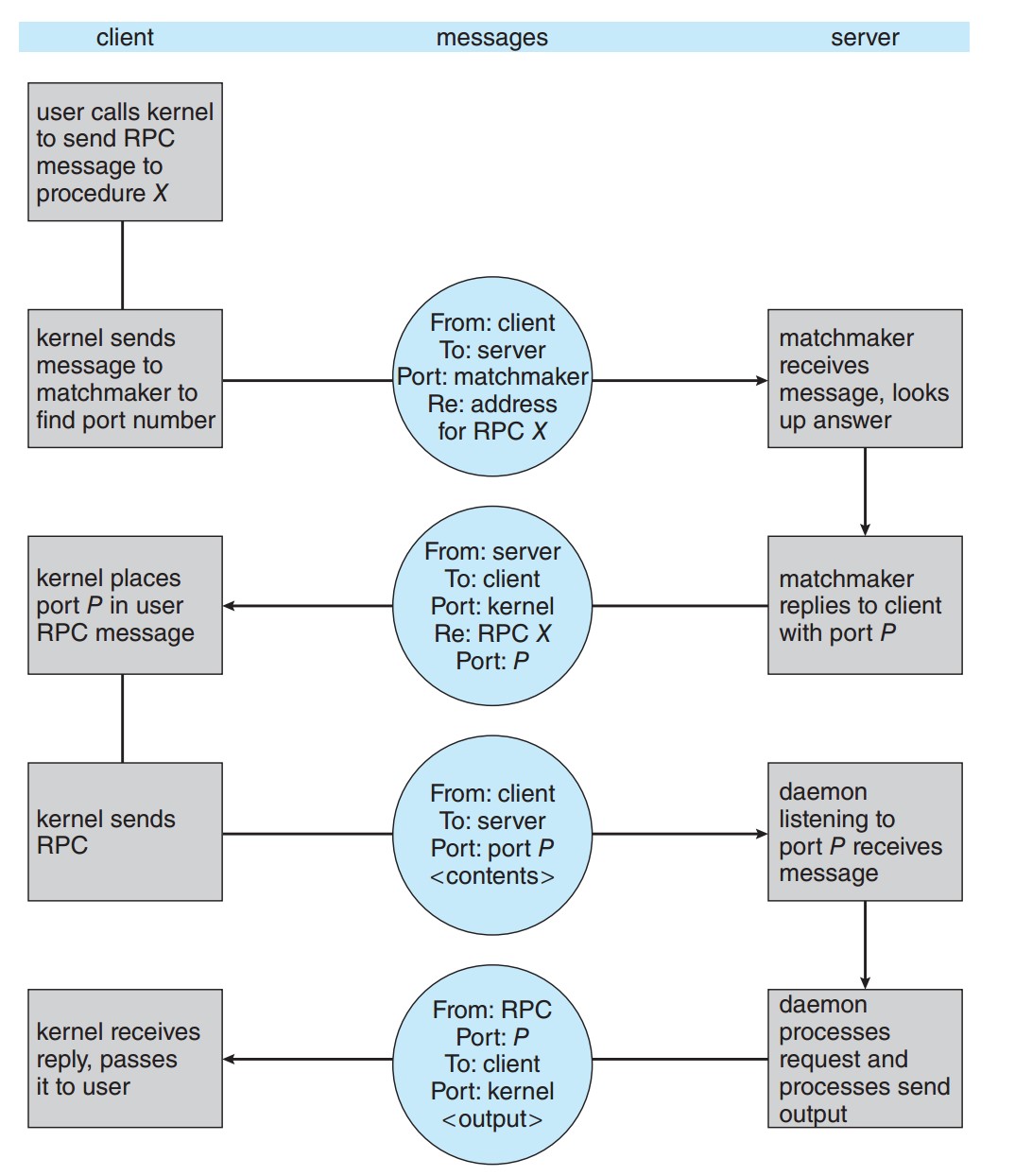
- Binding can be static (pre-determined port numbers) or dynamic (rendezvous mechanism for port discovery).
- Dynamic mechanism is also called a matchmaker
- Dynamic binding allows flexibility but adds initial request overhead.
-
Use Cases:
- RPCs facilitate distributed file systems and other networked services by specifying operations like read, write, rename, etc.
- Android uses RPCs for Inter-Process Communication (IPC) within its binder framework, supporting background services without user interfaces.
-
Android Application Components:
- Services run in the background for long-running operations or network communication.
- Bound services communicate with client apps using message passing or RPCs, implementing the
onBind()method for binding and service provision.
-
Android Binder Framework:
- Handles parameter marshaling, process communication, and method invocation for services.
- Utilizes Android Interface Definition Language (AIDL) for defining service interfaces and creating stubs for remote service interaction.
Last updated on